Latest Additions and Updates

Amphiura ptena
This small brittle star has five arms and a flower-shaped disc, with long visible radial shields and large scales. It is tan in colour, with pinkish-orange to red markings on the disc and arms, although the exact pattern can vary. The spines on its arms are short and stubby, but dense. It is very similar to Amphiura constricta, but the reddish colouration distinguishes it.

Reticunassa compacta
This small snail can be variable in colour, but is often light with brown bands. It has spiral ribbing with axial folds. The whorls are convex and the body whorl in particular is quite bulbous. It is very similar to other snails in the family Nassariidae, and the main distinguishing feature is the regular conical shape, more elongate than Tritia burchardi or Nassarius pauperatus but without the straight whorls of Nassarius pyrrhus. This species also bears a close resemblance to Austromitra analogica, but its whorls lack the obvious shoulders of that species.

Sinum Zonale
This infrequently encountered snail has a white/tan, low-spired shell with a very large aperture. The animal itself is much larger than its shell and is white. It usually spends its time buried in soft sediment and so it is rarely seen when alive. However, its egg masses, which resemble sandy, circular "collars" are often seen on the sea floor.

Carijoa cf. smithi
Whether this is Carijoa smithi, C. riisei or a separate species is unknown, but this distinctive branching coral is often found on jetty pylons. Unlike the mat-forming Carijoa cf. multiflora, this species consists of long, pale orange branches, from which the white, 8-tentacled polyps emerge.

Hydrodendron australis
This large bushy hydroid consists of many, largely parallel stolons with single polyps (hydranths) densely arranged along their lengths. Many hydroids are difficult to differentiate without expert examination, but this species is somewhat distinctive because it is branched, but neither tiny, delicate or uniformly pinnate, unlike many of its relatives.

Soldier
Gymnapistes marmoratus
Relatively common in shallow water, the Soldier or South Australian Cobbler spends its time on the sandy seafloor or in seagrass beds, where it has been responsible for many nasty stings from its venomous dorsal spines. A mottled tan and white, this species has a number of large brown blotches over its body, including a thick band across its large eye. It also has two large spines that can protrude out sideways from the nostrils, although they are usually pressed back against the head under its eyes. It is quite similar to many scorpaeniform fishes, particularly the gurnards (family Neosebastidae), from which it can be differentiated primarily by its blunter snout and well-defined eye-band.
Gulf Gurnard Perch
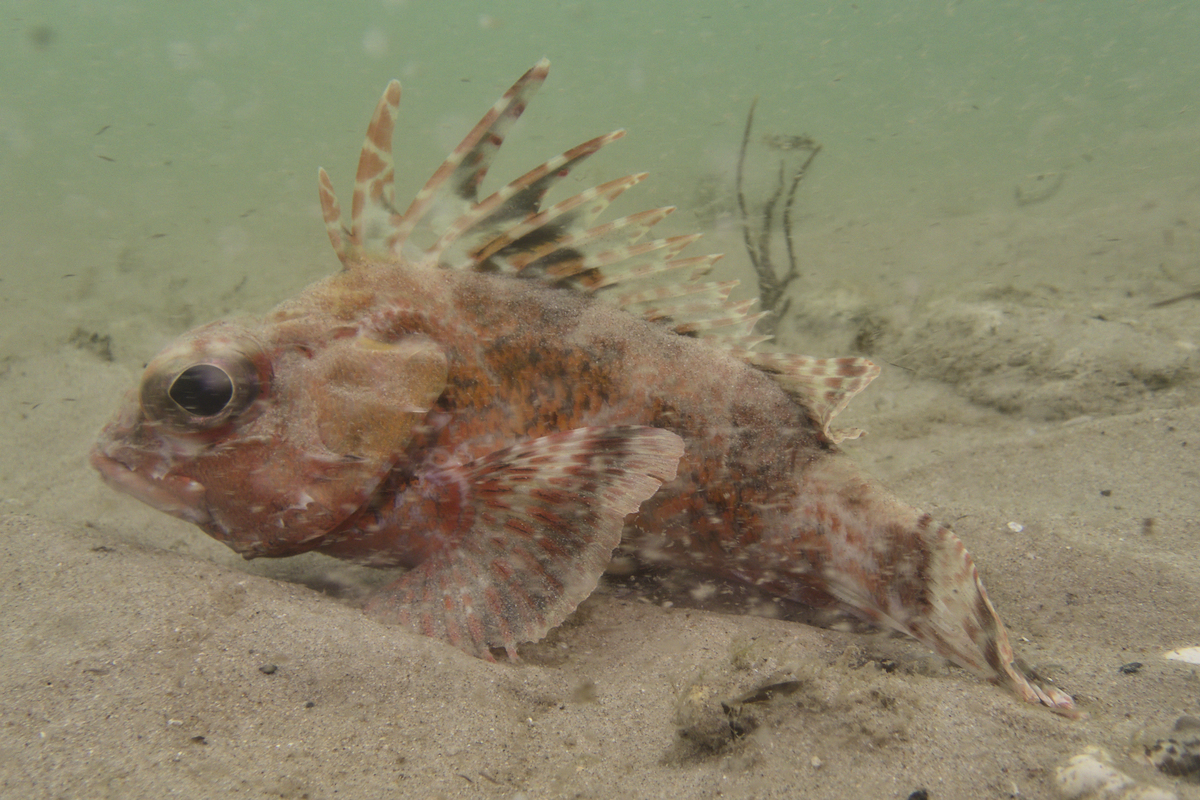
Neosebastes bougainvillii
This gurnard perch is usually found in deeper waters, although ocean conditions can drive it into shallower waters from time to time. It is a reddish-cream in colour, with brown blotches, including a prominent blotch behind the operculum that extends up onto the dorsal fin. It is difficult to distinguish from other Neosebastes species, especially N. scorpaenoides, although its shorter first dorsal spine, reddish colouration, and spotted tail band (as opposed to the more solid band at the rear of N. scorpaenoides' tail) can help to differentiate it.
Pyrgulina pupaeformis
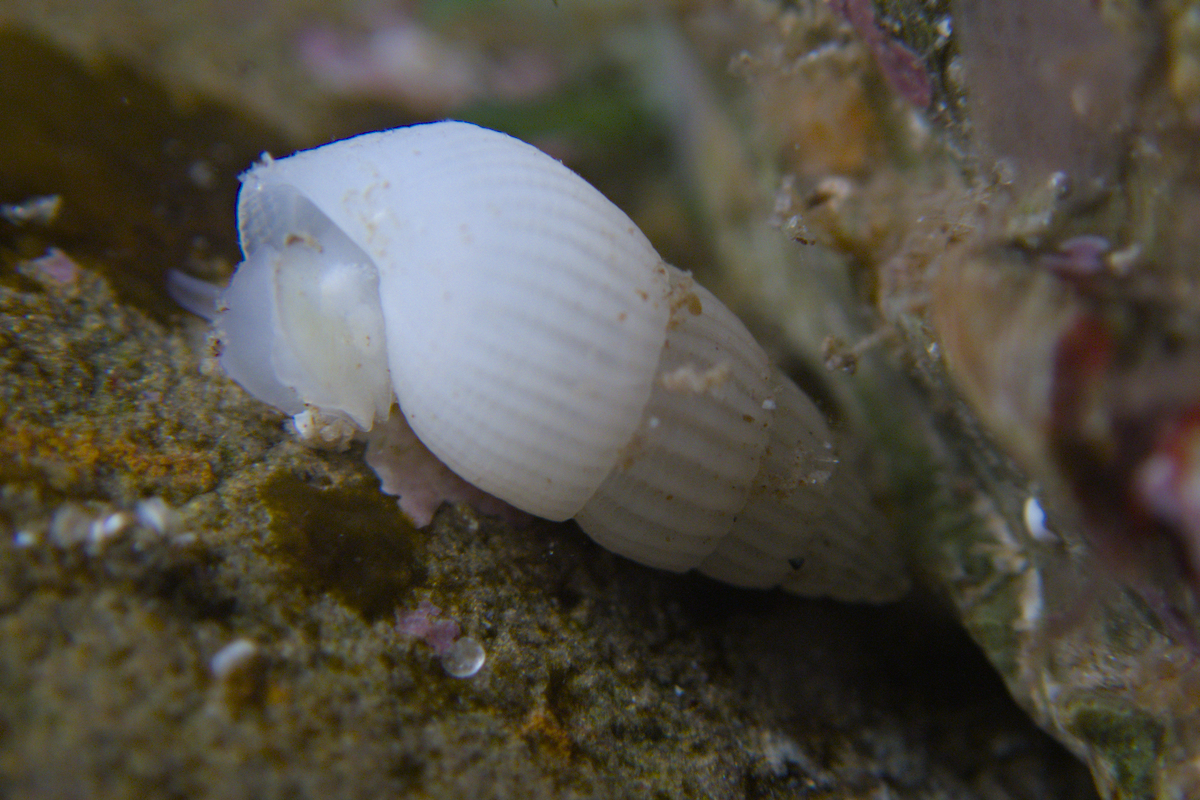
Found in both tropical and temperate Australian waters, this heterobranch snail has a white shell with soft axial ribbing and rounded whorls. It shares similarities with a number of species, most notably Rissoina fasciata, from which it can be distinguished by its comparatively straight ribbing, contrasted against the oblique ribbing of R. fasciata.

Strahlaxius waroona
A rarely encountered mud shrimp, this species is thought to feed in soft sediment. It is mostly white to pinkish in colour with a bluntly tapered, but serrated, rostrum.
Pygmy Thornback Skate
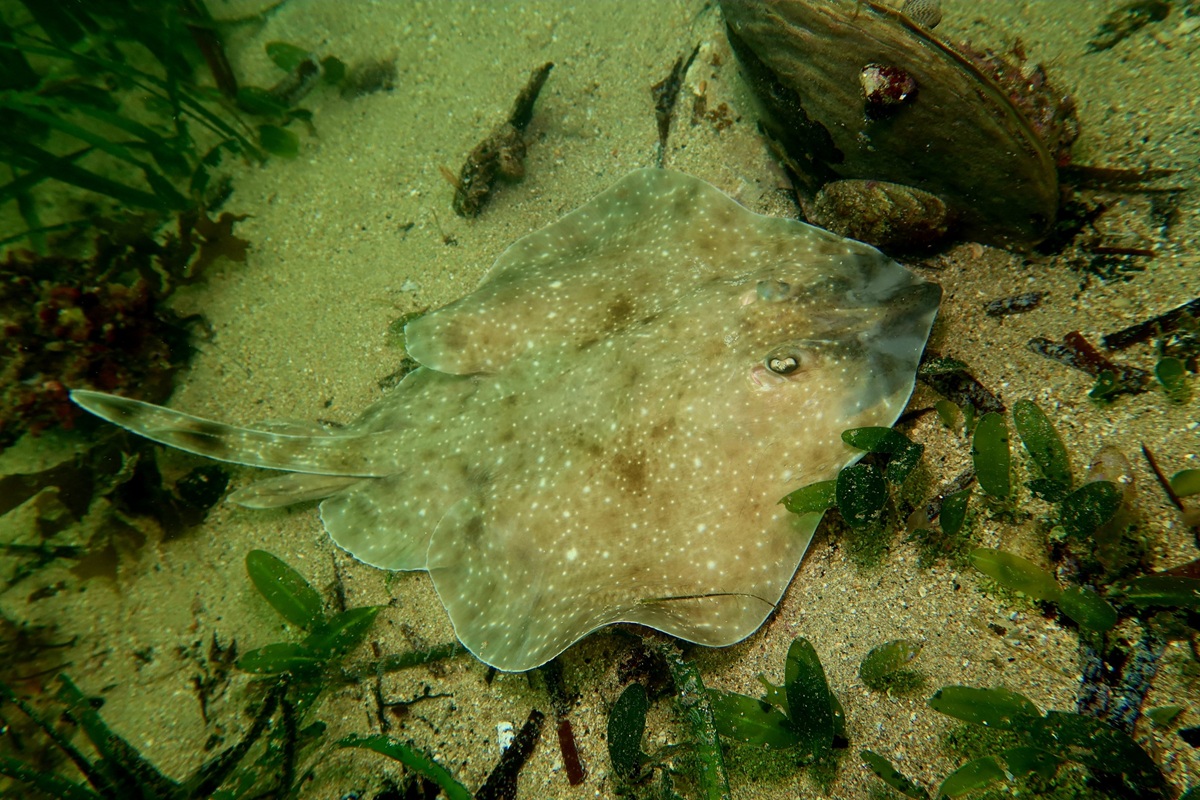
Dentiraja flindersi
Previously only recorded from depths of over 20m, little is known of this rarely-encountered species. Its dense cover of white spots distinguish it from most other skates, while its relatively blunt snout is the best way to differentiate it from its relative, the Whitespotted Skate (Dentiraja cerva), another deeper water species.